OK, so I retrofitted a factory Oxygen system
into my B55 HERE and have found it to be a great
improvement in my O2 Saturation at my usual cruise altitudes of 10,000' to
13,000' and at night. It got me from the low 80's into the low 90's with a very
nice oxysaver cannula
for optimizing my on-board oxygen supply.
See an in cockpit Bonanza O2 Bottle Mounting
solution by a Bonanza owner HERE.
Still not convinced about the benefits of O2 in
the cockpit - Read about and listen to this chilling hypoxic
pilot audio conversation with ATC
HERE
Having price checked a few FBOs on the road
for oxygen bottle top offs and/or fills, I was shocked at what I was quoted for
this service. In most cases $65 or MORE!
This CSOB was
not about to fork over the equivalent of nearly an hours worth of 100LL for O2.
I had heard of many oxygen fill stations folks
had installed in their hangars and set out to research how to safely accomplish
this to do my own bottle fills in a cost effective manner.
WARNING
High Pressure
gasses are DANGEROUS! Do not attempt to build or operate high pressure gas or
oxygen systems without proper training. If in any doubt, consult a high pressure
gas professional or your A&P/IA who works with high pressure gasses on a regular
basis for guidance.
OR
Offer to pay for
the components and the system and let your A&P/IA build it and work out a
mutually acceptable compensation to service your system.
Check out the
below video for the results of incorrect oxygen cylinder handling
Here is a hair raising story
that could have had a very bad ending were it not for the sharp thinking of the
owner!
So, I'm in Memphis for a couple of days visiting my daughter and her family
and ask the FBO to put in the O2.
I get to the airplane the next morning to check things out and the first
thing I look at is the O2 pressure. It's below 400psi. I gently back away from
the aircraft and tell the others to get back as well. Clearly there was a leak
(the FBO definitely had topped it off). Apparently they didn't snug the cap
back on the fill fitting and the check valve had a slight leak. They said they'd
top it off again and snug it up.
They are incredulous when I tell them to leave it open for an hour before
messing with it. But I have my reasons: There is an entire aircraft interior
oxygen soaked overnight. Anybody that thinks this country boy is gonna climb in
and crank up is out of their ever lovin' mind. Oxygen blowing out of a line is
one thing. Combustibles long term soaked in 100% of the stuff (it's down in the
gaps of the fibers and *in* the fibers) is "sort of flammable".
On reflection I wasn't sure an hour would do it, so I called them back and
told them to leave it for three (with the doors open). I wasn't leaving until
the next day anyway. I'm sure they still think of that crazy Texas guy. Call me
chicken, but not fried!
With the above warning as a backdrop, here is
a narrative on how I constructed my system.
I secured an account with a local welding
supply place for two full size tanks of Oxygen for about $20 each and a
$12/month cylinder rental charge. Understandably, there are different schools of
thought as to Welding O2 and ABO (Aviator Breathing Oxygen). Here is a quote
from Mountain High's
Technical Information Manual:
Contrary to a common and published myth, there are no
different grades of oxygen being produced or contained in cylinders maintained
under DOT regulations. By the very nature of the state-of-the-art process in
which oxygen is produced, it will be better than 99.99% pure.
In other words, it all originally comes from the same spout
no matter what the purpose. In addition, oxygen for medical use does not have
any more moisture than oxygen for any other purposes, nor is it added.
Furthermore, because of the chemical nature of oxygen it must be as pure and dry
as possible if stored under pressure or else the cylinder and equipment may be
damaged, or worse, personal injury or death may occur.
Therefore, a hygiene protocol is necessary in order to
prevent oxygen from being contaminated or to help keep contaminated oxygen from
being used. This, perhaps, is why many believe there are different grades of
oxygen.
For me, I'm satisfied that the many folks I've
spoken to and the above source, that I can successfully use Welding O2 for my aviation needs
without issues. I have learned that in some states if you ask for Medical O2 you will need to
present an Rx or some such thing.
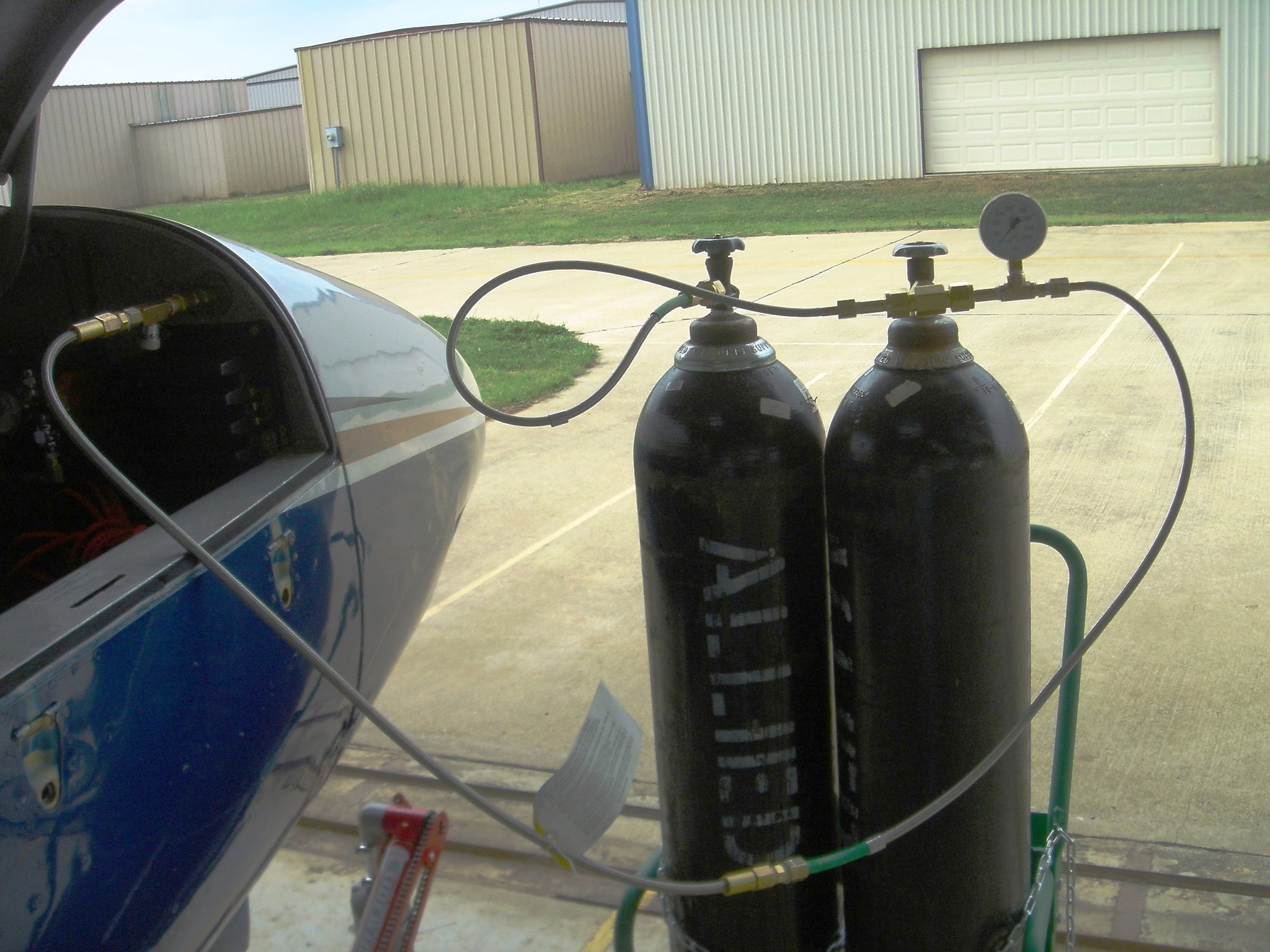
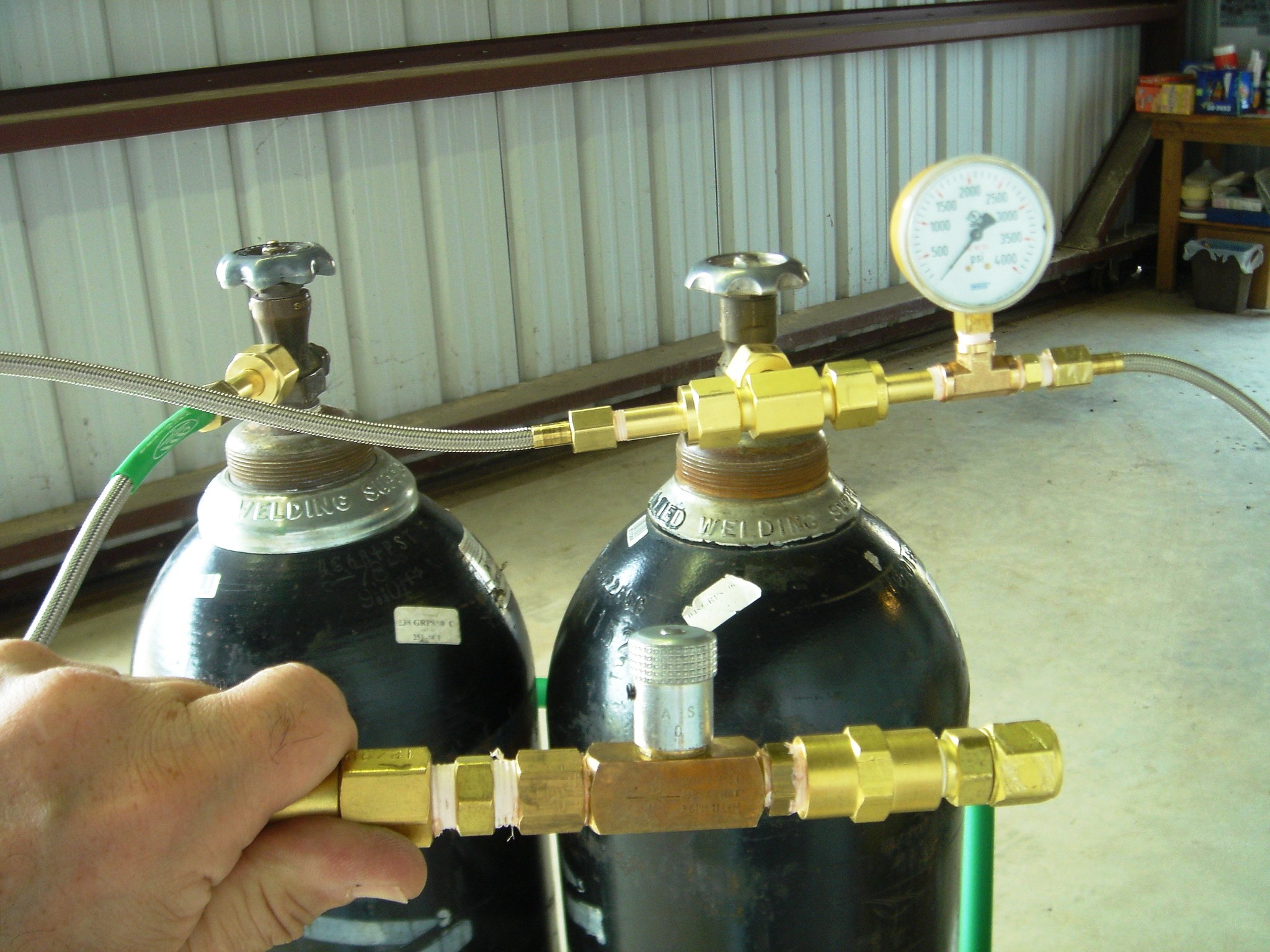
Each tank has about 250 cubic feet of O2 in it
and is filled to about 2,200 psi. I hung a tag with a number on each tank "#1"
and "#2". I start with tank #1 and use that until I can no longer get 1,850psi
from it. Then I close Tank #1 and open the valve on Tank #2 and top off my
bottle.
My original plan was that when bottle #2 gets to 1,850psi, bottle #1 is going back
for exchange and bottle #2 will become bottle #1 and the freshly filled bottle
becomes bottle #2. Beech Lister Mike T. gave me some thoughts on optimizing my
oxygen cascade so I'm going to experiment with Mike T.'s thoughts below.
Here are some CSOB oxygen filling thoughts
from Mike T., an experienced Baron and Bonanza owner who refills his own oxygen
bottles:
You'll waste much less oxygen if you use both supply tanks
each time you refill your aircraft's tank. (Except when both supply tanks are
nearly full.) The idea it to first draw on your lower-pressure tank until its
pressure equals that of the tank in your aircraft and then switching to the
higher-pressure tank to top off the aircraft tank.
Again, this procedure is used for each refill. If your
aircraft's tank is nearly empty, you'll be able to get a lot of O2 from even a
partially filled supply tank. This will of course mean less is drawn from the
higher-pressure tank. This is the primary reason to connect the supply tanks in
a cascade. It makes drawing from several tanks during one refill much easier;
fewer connections to make; just turn the handles on the valves.
Also, the economics of filling one's own tanks depends on the
refill/exchange policy of the gas supplier. Some air shops charge a flat rate to
exchange cylinders regardless of how much gas remains in the customer's tank.
Others -- particularly those that are willing to refill a customer-owned tank,
rather than exchange it -- charge only for the gas it takes to top it off, pee
vee equals en are tee, etc. Any card-carrying CSOB will check with several local
suppliers before choosing one.
Finally, depending on your itinerary, it's frequently OK to
only partially fill your aircraft tank. You only need enough O2 for the upcoming
flight. Partial refills will help you get more gas from your supply tanks as
they're depleted.
Great thoughts Mike!
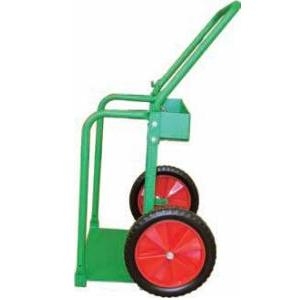
I got a 2-bottle oxygen cart off eBay for
about $69 including shipping a number of years ago. It looks fine for my light duty needs in my hangar
and has restraining chains and sits the bottles on a platform that rests with
the 12" wheels off the ground. Below is a nice Amazon O2 Cart offering that is similar to the one I bought years ago.
There are much more expensive and industrial strength
carts out there but I did not think I needed that kind of commercial durability.
I sourced a lot of the fittings and high
pressure oxygen "whips" from
Applied Home Healthcare
in Westlake, OH 888-327-7301.
They had most of what I needed and were CSOB priced from what I could research.
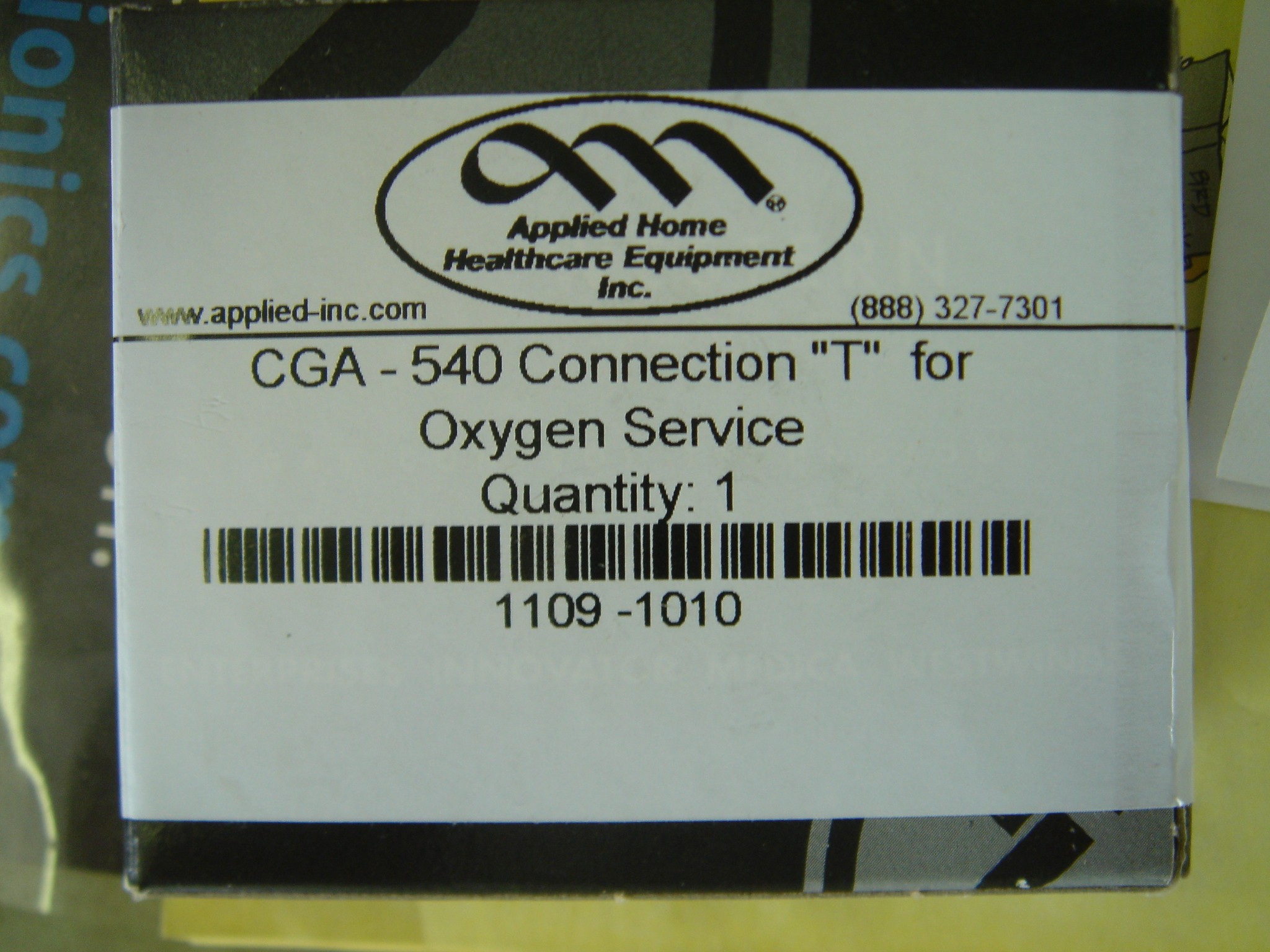
For bottle connections I used the CGA540 fittings. Here is the "T"
(aka Western Enterprises PN: T62) and pigtail whips
I purchased:
The whips are provided with 1/4"
NPT female ends and cleaned, capped and packaged for Oxygen service. I used a
1/4" NPT
Male-to-Male adapter to put two of them together.
Here is my parts list:
(1) 1109-1010 CGA540 "T"
(3) 1109-9914 CGA540 Nut
(3) 1109-9916 CGA540 Nipple
2.5" Length
(3) 1110-0536 Teflon Braided
Pigtail 36" (One of these could have been 24")
(1) Two Cylinder Tank Cart
w/Restraining Chains and >10" Wheels
I used three (3) of these CGA540 nuts and three (3) nipples
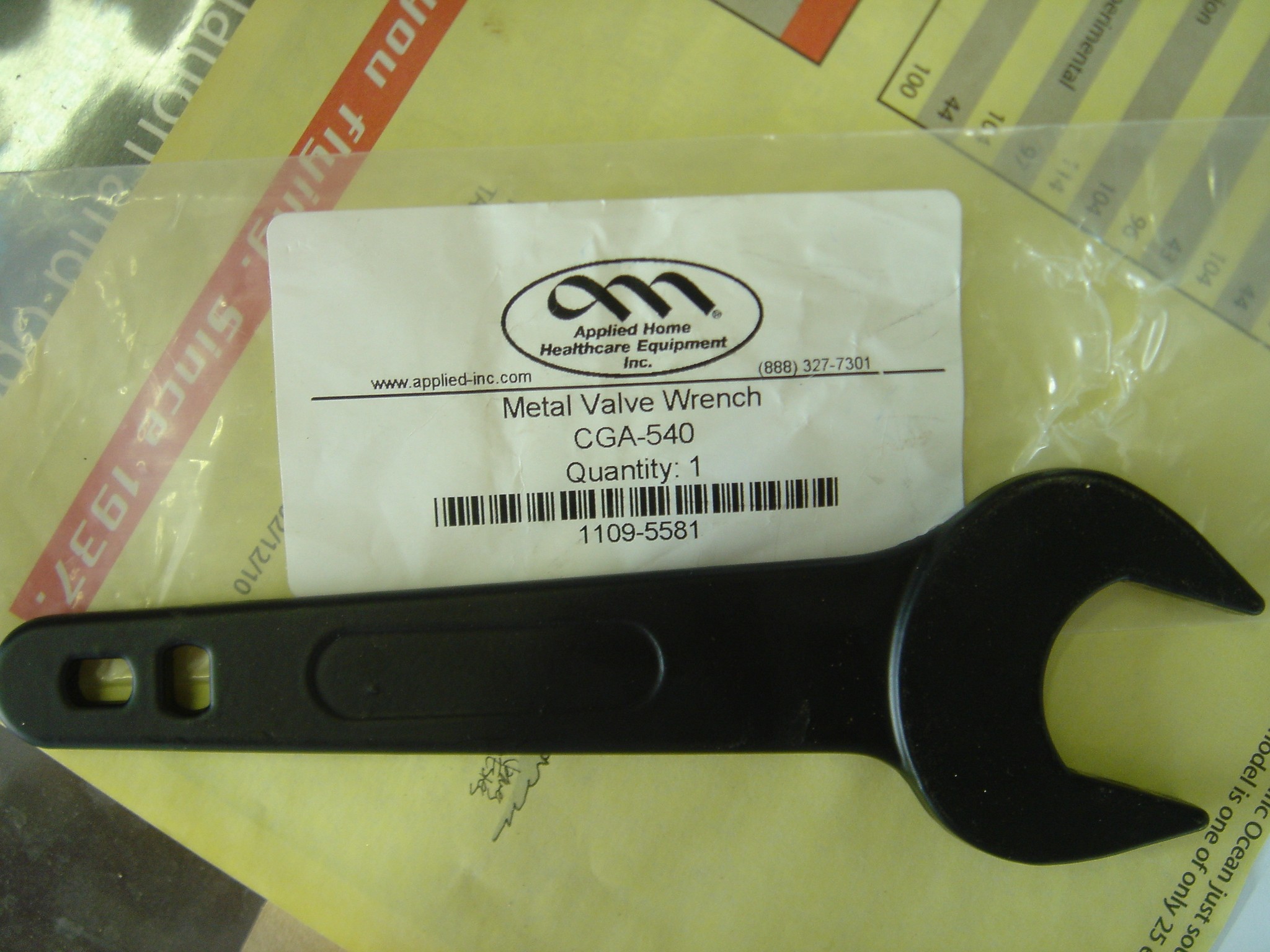
I thought getting a CGA540 wrench for ~$13 for my
filling station was a good idea for when I have to switch tanks. The wrench can
be conveniently placed in the cylinder cart tray as well as the wrench for
attaching my filling adapter 11/16"
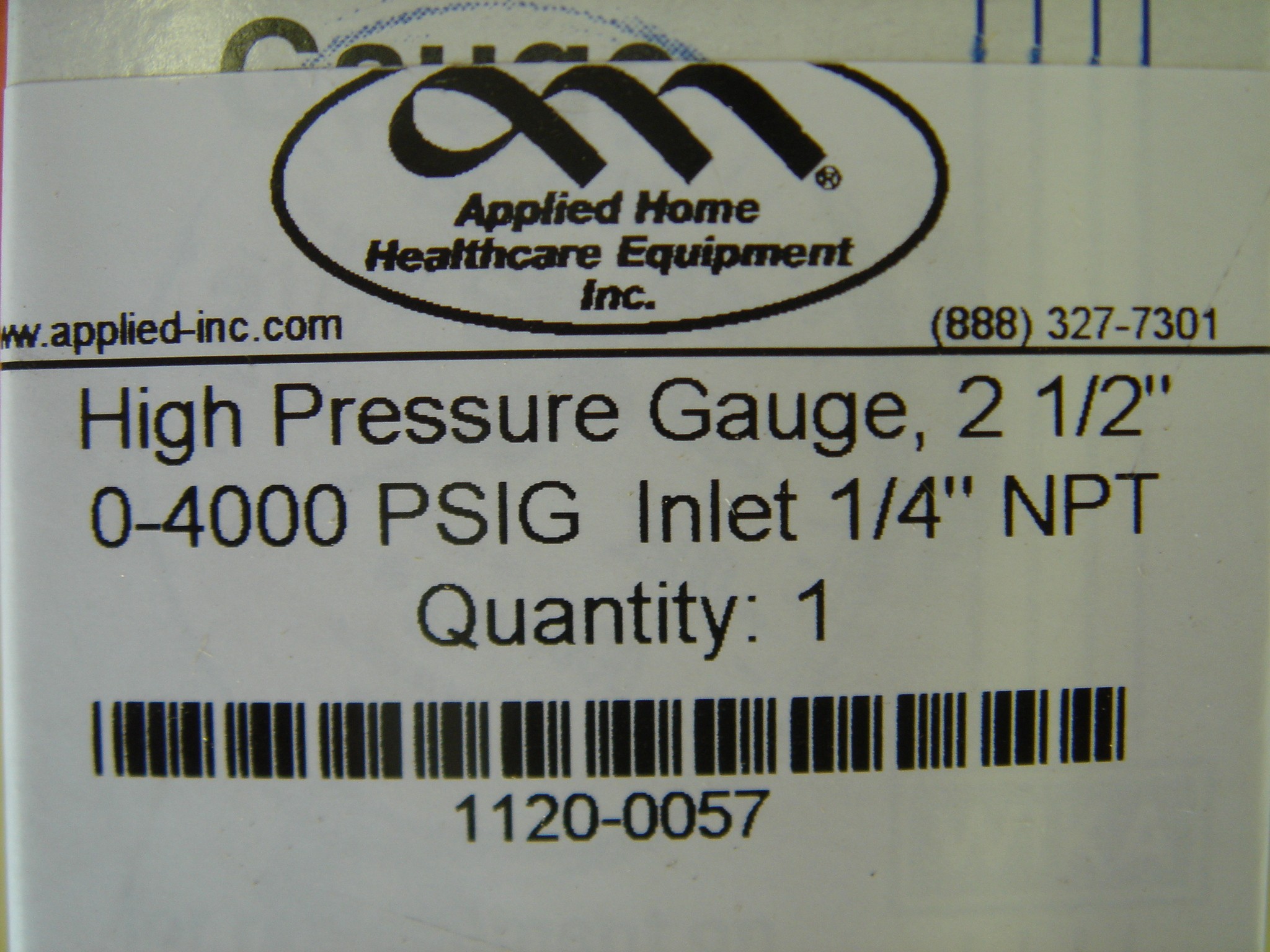
Here is the 2.5" high pressure gauge I
selected @ about $15. It has a 1/4" NPT Male fitting and was placed into a 1/4"
NPT Female "T" that I sourced locally
I think one of the most important pieces of my
fill system is the needle valve. This allows me to control the rate of the fill
so that the little bottle is not filled too quickly. My research has determined
quite a number of warnings regarding too fast a fill rate which will heat the
bottle being filled. The reading I have done suggests that if you can
comfortably rest your hand on the bottle things are good.
My friend and Bonanza owner, Bo H. is an avid
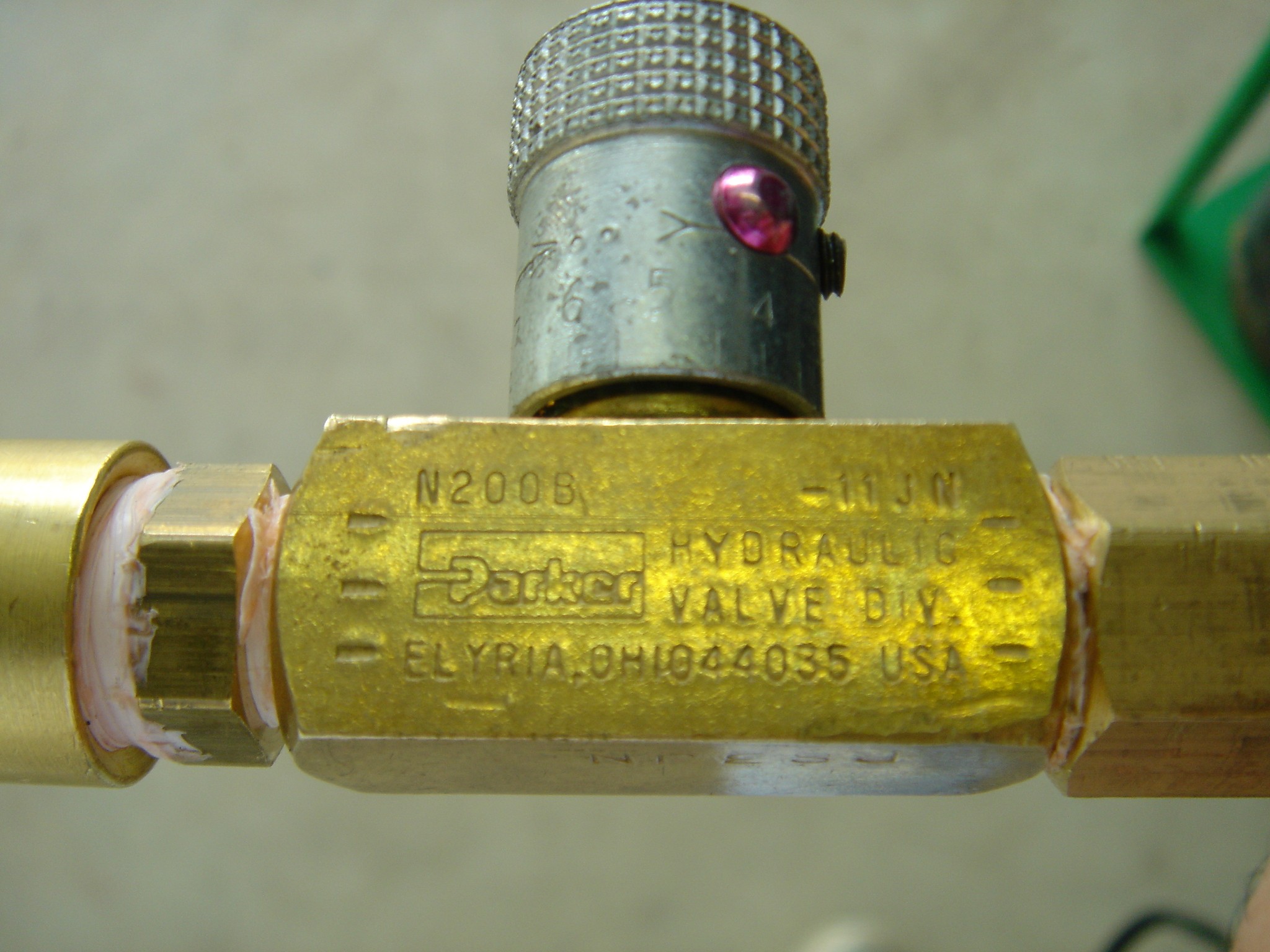
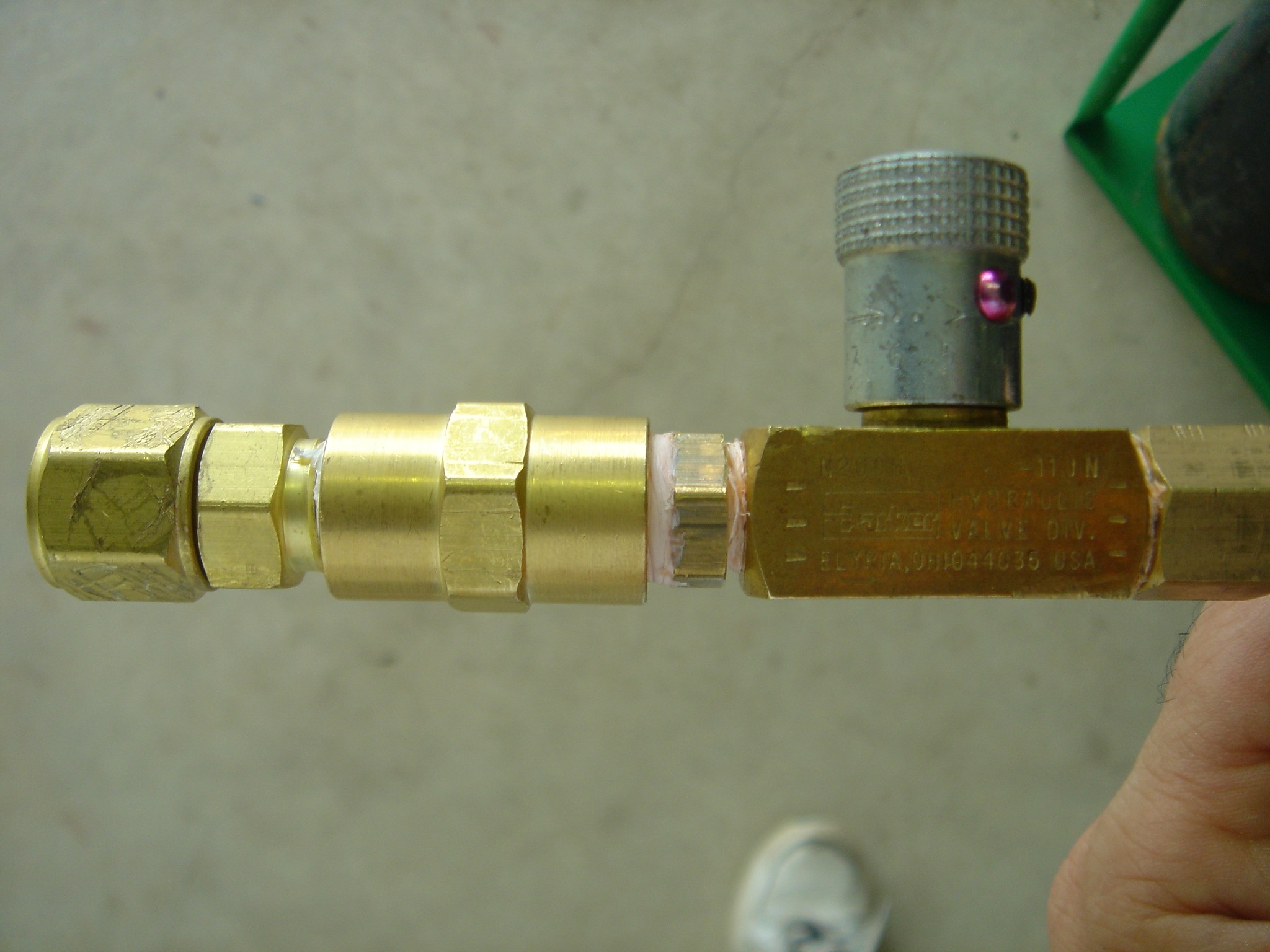
scuba man and he had a needle valve specifically for this purpose. It is Parker
PN: N200B with 1/8" NPT Female Ends. It has a 3GPM flow rate, however, I opened
the valve just to the beginning of flow and that was a good rate for me. I used locally
sourced brass adapters to attach this to the 1/4" NPT high pressure whip and the
Scott adapter fitting.
Here is a 1/4" NPT Needle Valve, the
N400B that could integrate nicely into your 1/4" NPT high pressure whips
with a 5GPM flow rate. For additional safety I have decided I'm going to add the
N400B to my system just downstream of the pressure gauge to protect the flow
rate in the long section of whips.
Click
HERE for a link to all the Parker N-Series Needle Valve Specs
HERE is an
Auction for a new
N200B at $15
from seller: clevelandsupply
The other piece of the fill system is the
adapter to the Beech factory fill port which is a "Scott" fitting. This piece
pictured at the left end of the photo below, was sourced from Aerox
HERE
My Oxygen Fill System in Use
Consider Carrying BOOST O2 Until You Get your System Installed
Or Until You get Your O2 Bottle Filled
Check out how Peter H., an aviator in the UK,
solved his O2 filling needs:
My buddy Bo H., is an O2 system and Mixed gas
Blender Instructor trainer, for TDI
www.tdisdi.com and NAUI
www.naui.com and here are some of his watch outs:
Cleaning is imperative, "Crystal" simple green absent of the dye and perfume or
simple DAWN detergent is what the NAVY uses now. Clean till water no longer "
beads" or under a "black light' after 10 minutes no petroleum florescence.
This means- don't check your oil then open a tank.
Big pressure increases - filling to a closed
Scott pack valve or a sudden increase in pressure can have disastrous results
The proper O2 compatible Teflon tape is important too. Source this from your
welding supply or industrial supply house.
ANY PETROLEUM PRODUCT - grease gas even cigarette tar, ignites very easily in
the presense of pure oxygen - and
starts a chain of more stuff burning till the O2 is gone. Possibly creating a
3,500F, 8 foot fireball.
Below is an excerpt on Oxygen tanks and their recertification
requirements by Beech owner/ABS Member Pete Tracy, which was published in the
ABS Magazine in 2005. Also, HERE is an article on
oxygen cylinder care and servicing.
REQUALIFICATION OF OXYGEN CYLINDERS
Most pilots who use oxygen cylinders in their planes have a general sense
that their cylinders need to be re-tested and re-certified every so often. But
few of them actually know what is required. This article is intended to give a
general overview of these requirements.
Re-testing and re-certification is technically called "requalification."
Requalification of oxygen cylinders is governed by regulations of the Department
of Transportation (DOT) and not by those of the Federal Aviation Administration
(FAA). The DOT regulations govern cylinders used for transportation of hazardous
materials.
Compressed oxygen is a hazardous material. (49 CFR Section 172.101,
Table). Each cylinder used for the transportation of compressed oxygen must
meet DOT specifications and bear DOT specification markings and be "qualified."
No one may use an unqualified cylinder in transportation.
Such cylinders must be "requalified" at certain times and under
certain conditions. Requalification must be done by a person holding DOT
approval. (Section 180.205). Cylinders which are not qualified or requalified
may not be refilled. And federal OSHA regulations require that anyone who works
with oxygen or oxygen systems receive special training. (29 CFR Section
1910.253(a) (4).
Regardless of time, a cylinder must be tested and inspected if:
1. The cylinder shows evidence of dents, corrosion, cracked
or abraded areas, leakage, thermal damage, or other conditions that
might render it unsafe for use it transportation;
2. The cylinder has been in an accident and has been damaged
to an extent that may adversely affect its lading retention
capability, or;
3. The cylinder shows evidence of or is known to have been
over-heated. (Section 180.205(d)).
This is called "conditional requalification."
Regardless of condition, a cylinder must be tested and inspected
after
the passage of a certain period of time. This is called "periodic
requalification." How often a cylinder needs requalification depends on the
kind of cylinder-and there are many kinds of cylinders. However, the most
commonly used cylinders in aviation are Types 3A, 3AA, 3HT, 3AL and E(xxxx).
Type 3A and 3AA cylinders are heavy steel, must be requalified every
5 years, and have an indefinite lifetime. Type 3HT cylinders are light steel,
must be requalified every 3 years, and must be condemned after 24 years or 4,380
fills. Type 3AL cylinders are aluminum, must be requalified every 5 years, and
have an indefinite lifetime. (Section 180.209).
Aluminum cylinders made from type 6351-T6 alloy have special
requalification requirements because they have had failure problems. (Section
180.205(f) (4)). There is a proposed regulation to prohibit the use of this
alloy in cylinders.
Type E(xxxx) cylinders are Kevlar or a similar material, must be
requalified every 3 years, and must be condemned after 15 years.
These time periods may be extended under certain circumstances. For example
Type 3A or 3AA heavy steel cylinders can be requalified every 10 years, instead
of every 5 years, if "removed from any cluster, bank, group, rack or vehicle
each time it is filled," meets certain other specifications, and is subjected to
the dreaded "hammer test" at every filling.
(Section 180.209 (b)).
Each cylinder that is tested and inspected must be "requalified",
"rejected" or "condemned." If a cylinder is rejected, the owner must be notified
in writing and have an opportunity to have it requalified under more rigorous
terms. (Section 180.211). If a cylinder is condemned, the tester must stamp a
series of Xs over the DOT specification number and mark it "CONDEMNED."
Alternatively, with the consent of the owner, the bottle may be rendered
incapable of holding pressure-usually by drilling. No person may remove or
obliterate a "CONDEMNED" marking. (Section 180.205(i) (2)).
A cylinder must be condemned if:
1. It fails the visual inspection;
2. It leaks through its wall, or:
3. There is evidence of cracking. (Section 180.205 (i) (1)).
In addition to both internal and external visual inspection, each
cylinder must be pressure tested. This is commonly called "Hydro-Testing" or
"Hydro-Static Testing." During a hydro-static test the cylinder is placed inside
a test jacket filled with water, and a specified internal pressure is applied.
Most cylinders are tested to 5/3 their certified pressure. Thus, a cylinder
having a service pressure of 3000 pounds per square inch would be tested to 5000
pounds per square inch. How much the cylinder expands during pressure testing is
measured. And how much the cylinder has permanently expanded from the pressure
testing is also measured. (Section 180.205(g)).
If a cylinder passes its requalification testing, it must be marked with the
month and year of requalification. It must also be marked with the requalifier's
identification number (RIN). (Section 180.213). If a cylinder was requalified
in November, 2003 by a requalifier holding a RIN of A221, the requalification
mark would look like this:
B3
2 05
52
Cylinders are also marked with Crown Markings which are normally on the
shoulder of the cylinder. Suppose for example a cylinder was marked: DOT-3AL2216
HH34087 03/01 LUXFER TC-3ALM153. These markings mean: The cylinder is a DOT
approved Type 3AL aluminum cylinder with a service pressure of 2216 pounds per
square inch. It has a serial number of HH34087. It is made by LUXFER. It was
made in March, 2001. It was certified by Transport Canada as a Type 3ALM
aluminum cylinder with a service pressure (in bars) of 139.
Another example might be: DOT-3AL2015 NN0366194 M4002 08 02 CATALINA M15
TC-3ALM139. These markings mean: The cylinder is a DOT approved Type 3AL
aluminum cylinder with a service pressure of 2015 pounds per square inch. It has
serial number NN0366194. The M4002 is the DOT manufacturer's number issued to
CATALINA. It was manufactured in August, 2002. It is an "M" cylinder having a
capacity of 22 cubic feet. It was certified by Transport Canada as a Type 3AL
aluminum cylinder with a service pressure (in bars) of 139.
So go out to the hangar and check your oxygen cylinder. You will find out a
lot more than you already know. If your cylinder is out of date, you must have
it requalified before it can be re-filled. The manufacturer of your oxygen
cylinder can requalify it for you for around $60, but you will have to ship your
cylinder to them. However, many fire equipment businesses and dive shops can
also do the requalification for you. Usually these businesses are local, easily
accessible, and will charge around $25.
Maintaining your oxygen cylinders in top-notch shape is important. A leaking
oxygen cylinder can cause instant and spontaneous combustion of nearby flammable
material. A catastrophic failure of an oxygen cylinder will almost certainly be
fatal. There is a reason for requalification of oxygen cylinders, and given the
implications of a failed oxygen cylinder, the price of admission is low.
1. Individuals should consult the regulations themselves respecting the
requirements for their own cylinders.
2. All references are to specific sections of Title 49, Chapter 180 of the
Code of Federal Regulations unless otherwise indicated.
WARNING
High Pressure
gasses are DANGEROUS! Do not attempt to build or operate high pressure gas or
oxygen systems without proper training. If in any doubt, consult a high pressure
gas professional or your A&P/IA who works with high pressure gasses on a regular
basis for guidance.
OR
Offer to pay for
the components and the system and let your A&P/IA build it and work out a
mutually acceptable compensation to service your system.
Check out the
below video for the results of incorrect oxygen cylinder handling





 Aviation Oxygen Bottle Filling System

 This CSOB was
not about to fork over the equivalent of nearly an hours worth of 100LL for O2.
This CSOB was
not about to fork over the equivalent of nearly an hours worth of 100LL for O2.





 Auction for a new
N200B at $15
from seller: clevelandsupply
Auction for a new
N200B at $15
from seller: clevelandsupply