|


Confused about Lean of Peak (LOP) Operations?
The folks at
Advanced Pilot Seminars
can teach you more about why flying your engine "Green" of
Peak is the best operating decision you can possibly make for the health of your
engine!
The folks at Advanced Pilot Seminars even have an
on-line course that you can purchase to get yourself
educated on what's really happening in the internal combustion event. People say
it's like "Myth Busters" for the operation of the piston aircraft
engine!
Check out this
LOP PowerPoint Presentation and this
EGT Leaning Presentation created
by
Advanced Pilot Seminars
for a
good grounding in why this is the most efficient and effective operating
technique for your air cooled horizontally opposed aircraft engine.
Check out the GAMI injectors page
HERE
Check out this
Engine Management Article written by Peter Holt
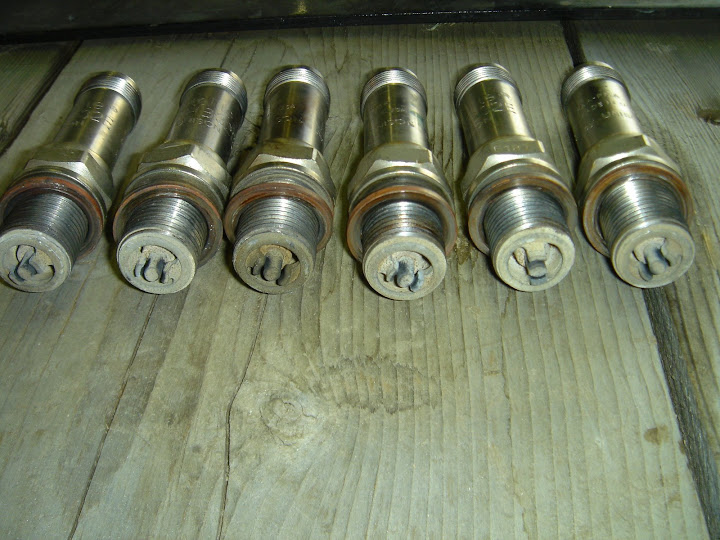
Below are pics of my spark plugs after 200
hours of Lean of Peak Operations. No self respecting CSOB wants to break or
damage anything expensive and that's a big part of why I run my B55 Baron LOP. The folks
running ROP are just kidding themselves and running their engines at the highest
internal combustion pressures possible (and also the highest CHTs).
Removing the fuel past peak EGT does not
melt cylinders, how the heck can removing the source of combustion energy do
anything but remove the intensity of the fire! Your CHTs will be lower and
that's a good thing for your cylinders.
Baron Owner and IA Stuart S. offers the
following simplified explanation of LOP operations:
"The combustion event begins with the spark
and the peak pressure occurs milliseconds later. LOP adds a bit of time to the
event. The higher the RPM, the further past TDC that the peak internal
combustion pressure occurs (ICP), resulting in less CHT."
This is another good reason to climb to your
cruise altitude at maximum continuous RPM!
LOP is so easy a Caveman could do it <grins>
See John Deakin's LOP guidance
HERE
Here's the rough math on my LOP operations:
Give up ~3% of airspeed and receive about ~16% better range or fuel economy!
To me, that's a great deal.
That's like getting 16 gallons of free fuel for every 100 gallons you burn! Or,
on a massive headwind cross country trip not having to make that fuel stop. PLUS
all the other advantages of lean and clean burning combustion operations inside
your engine.

Here are pics of my Exhaust stacks after a 5 hour LOP flight from KATW to KDTO
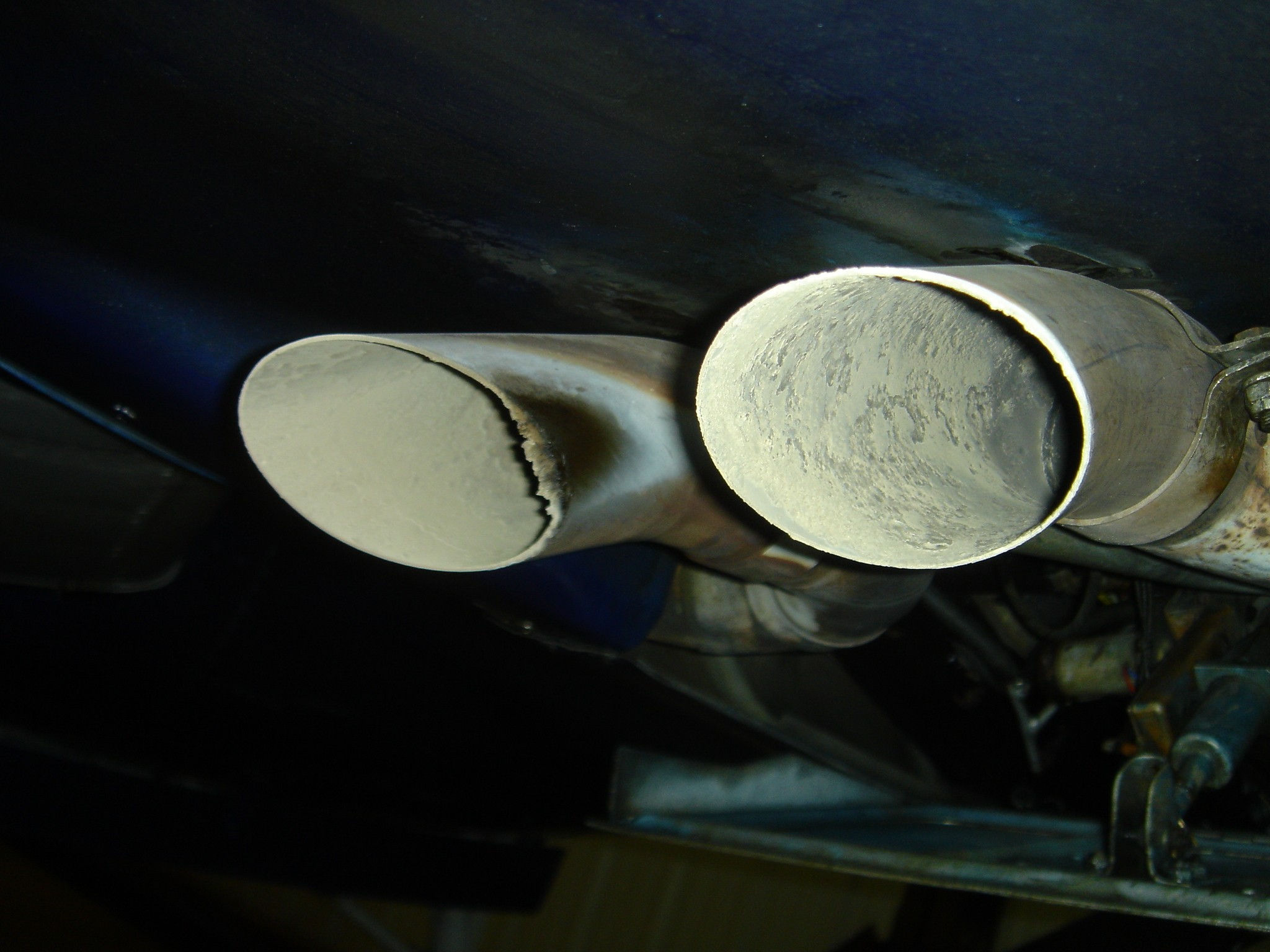
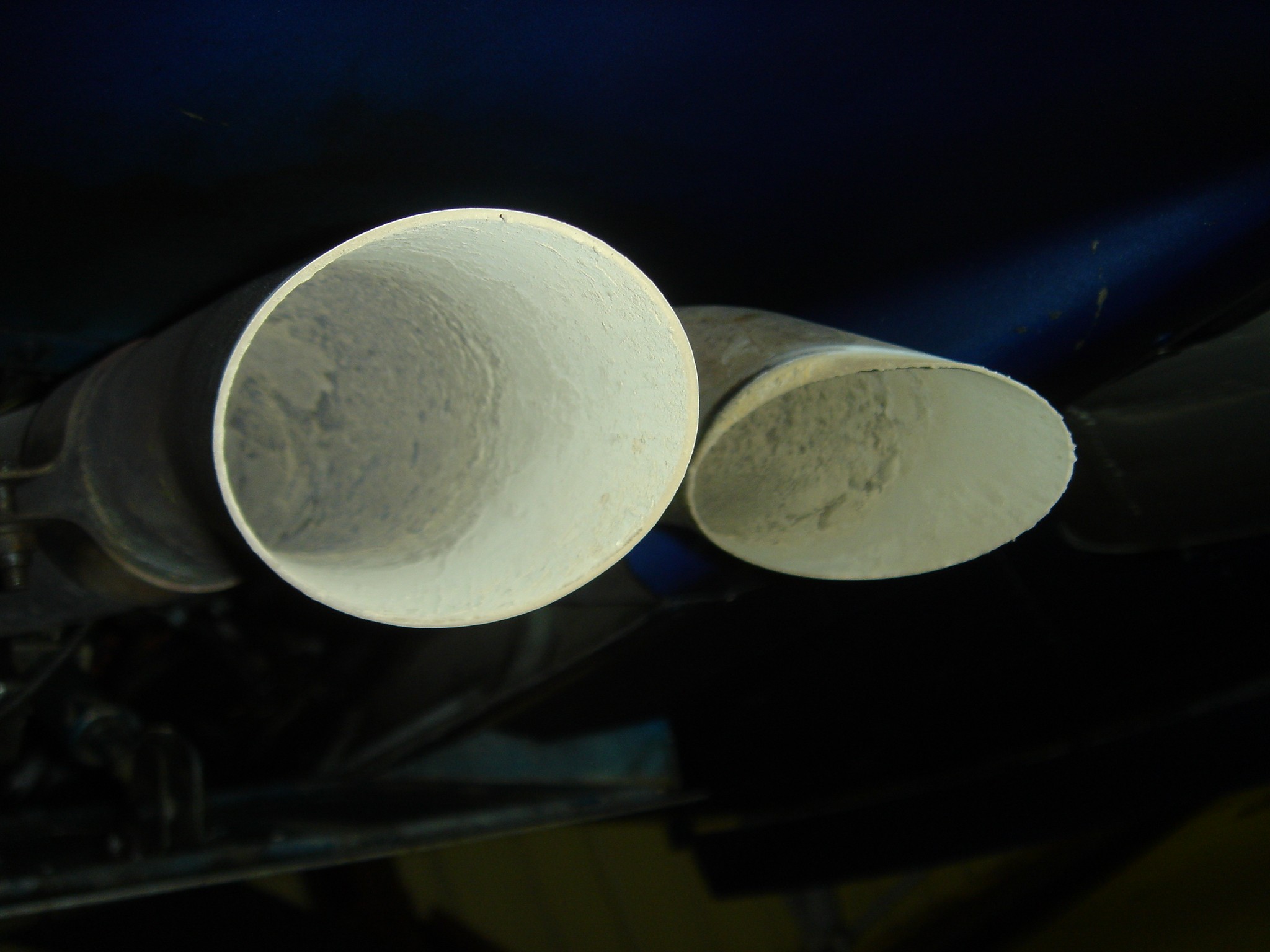
Left Engine
IO-470L
Right Engine IO-470L
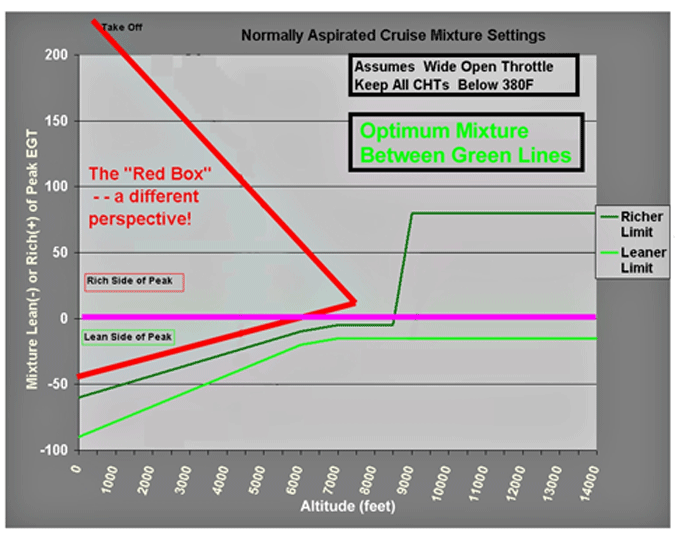
Here is their infamous
"Red Box" mixture vs. altitude diagram. Their recommendation is to
avoid operations in the "Red Box". Note that above 8,000' the Red Box
does not exist! You cannot hurt a normally aspirated engine with your mixture
settings at altitudes above 8,000'.
Still confused? Click the link above for their
seminar or on-line course.
 Learn to use this KNOB!
The Dangerous Red Box
Just where is that "red box" John Deakin keeps talking about? Some rough
numbers, good (that is to say, BAD) for most of these engines -- these are
"no fly zones," DO NOT set the mixture between them:
Red Box = No Fly Zone
- At and below about 60% power, there is no red box. Put the mixture
wherever you want it.
- At about 65% power or so, 100ºF ROP to Peak.
- At about 70%, 125ºF ROP to 25ºF LOP.
- At about 75%, 180ºF ROP to 40ºF LOP.
- At about 80%, 200ºF ROP to 60ºF LOP.
All those numbers are approximate! Please don't start splitting hairs,
here!
You probably don't want to run your engine between those mixture
settings. If you do, you are running very high peak pressures inside the
combustion chambers, and that peak pressure is occurring too close to top
dead center.
There's a chance you read too fast, and missed this very important point,
so let me put it another way:
Outside the Box
- At 65% power, use richer than 100 ROP, or leaner than peak EGT.
- At 70%, use richer than 125ºF ROP, or leaner than 25ºF LOP.
- At 75%, use richer than 180ºF ROP, or leaner than 40ºF LOP.
- At 80%, use richer than 200ºF ROP, or leaner than 60ºF LOP.
On most of these engines, with a properly set mixture at full rich, at
sea level, full power, the EGT ends up at about 250ºF ROP, with some as high
as 300ºF ROP and temps of 1250-1300F on most EGT monitoring equipment.
|
Lean of Peak Operation For IO-550 |
|
Lean of Peak Operation For IO-520 |
|
GPH |
HP |
GPH |
HP |
GPH |
HP |
|
GPH |
HP |
GPH |
HP |
GPH |
HP |
|
10.0 |
50% |
13.0 |
65% |
16.0 |
79% |
|
10.0 |
52% |
13.0 |
68% |
16.0 |
84% |
|
10.2 |
51% |
13.2 |
66% |
16.2 |
80% |
|
10.2 |
53% |
13.2 |
69% |
16.2 |
85% |
|
10.4 |
52% |
13.4 |
67% |
16.4 |
81% |
|
10.4 |
54% |
13.4 |
70% |
16.4 |
86% |
|
10.6 |
53% |
13.6 |
68% |
16.6 |
82% |
|
10.6 |
55% |
13.6 |
71% |
16.6 |
87% |
|
10.8 |
54% |
13.8 |
69% |
16.8 |
83% |
|
10.8 |
56% |
13.8 |
72% |
16.8 |
88% |
|
11.0 |
55% |
14.0 |
70% |
17.0 |
84% |
|
11.0 |
58% |
14.0 |
73% |
17.0 |
89% |
|
11.2 |
56% |
14.2 |
71% |
17.2 |
85% |
|
11.2 |
59% |
14.2 |
74% |
17.2 |
90% |
|
11.4 |
57% |
14.4 |
72% |
17.4 |
86% |
|
11.4 |
60% |
14.4 |
75% |
17.4 |
91% |
|
11.6 |
58% |
14.6 |
73% |
17.6 |
87% |
|
11.6 |
61% |
14.6 |
76% |
17.6 |
92% |
|
11.8 |
59% |
14.8 |
74% |
17.8 |
88% |
|
11.8 |
62% |
14.8 |
77% |
17.8 |
93% |
|
12.0 |
60% |
15.0 |
75% |
18.0 |
89% |
|
12.0 |
63% |
15.0 |
78% |
18.0 |
94% |
|
12.2 |
61% |
15.2 |
75% |
18.2 |
90% |
|
12.2 |
64% |
15.2 |
79% |
18.2 |
95% |
|
12.4 |
62% |
15.4 |
76% |
18.4 |
91% |
|
12.4 |
65% |
15.4 |
81% |
18.4 |
96% |
|
12.6 |
63% |
15.6 |
77% |
18.6 |
92% |
|
12.6 |
66% |
15.6 |
82% |
18.6 |
97% |
|
12.8 |
64% |
15.8 |
78% |
18.8 |
93% |
|
12.8 |
67% |
15.8 |
83% |
18.8 |
98% |
| |
|
|
|
|
|
|
|
|
|
|
|
|
|
Conversion Factor |
14.9 |
|
|
|
|
Conversion Factor |
14.9 |
|
|
|
|
Max HP |
|
300 |
|
|
|
|
Max HP |
|
285 |
|
|
|
| |
|
|
|
|
|
|
|
|
|
|
|
|
|
ROP Percent Horsepower Chart |
|
RPM |
|
MP |
2700 |
2600 |
2500 |
2400 |
2300 |
2200 |
|
29 |
100.0 |
97.5 |
95.0 |
92.5 |
90.0 |
87.5 |
|
28 |
96.5 |
94.0 |
91.5 |
89.0 |
86.5 |
84.0 |
|
27 |
93.0 |
90.5 |
88.0 |
85.5 |
83.0 |
80.5 |
|
26 |
89.5 |
87.0 |
84.5 |
82.0 |
79.5 |
77.0 |
|
25 |
86.0 |
83.5 |
81.0 |
78.5 |
76.0 |
73.5 |
|
24 |
82.5 |
80.0 |
77.5 |
75.0 |
72.5 |
70.0 |
|
23 |
79.0 |
76.5 |
74.0 |
71.5 |
69.0 |
66.5 |
|
22 |
75.5 |
73.0 |
70.5 |
68.0 |
65.5 |
63.0 |
|
21 |
72.0 |
69.5 |
67.0 |
64.5 |
62.0 |
59.5 |
|
20 |
68.5 |
66.0 |
63.5 |
61.0 |
58.5 |
56.0 |
|
|
|
|
|
|
|
Above charts courtesy of Beech
Lister Elliott S.
Here's what Lindbergh taught P38 Lightning pilots during WWII
Instructors warned WWII P-38 pilots
that running their fuel mixture lean would cause their engines to melt
down in mid-air. Charles Lindbergh told them to do it anyway.
His legendary 1927 solo flight across
the Atlantic didn’t just make him famous; it forced him to become one of
the world's foremost experts in squeezing every possible mile out of an
aircraft engine. When he arrived in the Pacific Theater during World
War II as a civilian technical representative, he brought this deep,
practical understanding of fuel conservation to pilots flying the P-38
Lightning.
In the Pacific, distance was a deadly
enemy. The twin-engine P-38 Lightning was a formidable fighter, but
pilots were strictly limited by their fuel range. Standard Army Air
Forces doctrine dictated running the engines in "auto-rich" during
cruise to prevent the engines from overheating or suffering severe
detonation.
Lindbergh knew from his Atlantic
crossing and years of test flying that the standard military doctrine
was overly conservative. Young fighter pilots were taught a simplified,
foolproof way to operate complex machinery to prevent them from
accidentally destroying their engines. Lindbergh, however, deeply
understood the thermodynamic relationship between manifold pressure,
engine RPM, and fuel mixture.
He confidently instructed pilots to
drastically drop their engine RPM—from the standard 2,200 RPM down to
around 1,600 RPM—while significantly increasing their manifold pressure
to maintain airspeed. Under these specific, low-RPM conditions, the
engines could be safely switched to "auto-lean" without causing
detonation or overheating. The lower internal friction at reduced RPM
offset the stresses of the higher manifold pressure, allowing the lean
fuel mixture to burn with maximum efficiency.
By adopting Lindbergh's unorthodox
engine settings, P-38 squadrons extended their combat radius by nearly
50 percent. This massive increase in range allowed fighters to escort
bombers all the way to distant, heavily defended targets and strike
Japanese forces that assumed they were safely out of reach. Lindbergh’s
supreme confidence didn't come from a reckless disregard for the manual;
it came from a profound, scientific mastery of internal combustion that
the manual's authors simply hadn't trusted average pilots to execute.
|




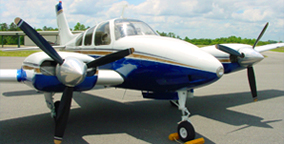

 Green of Peak Engine Ops (formerly LOP) Saves Gas & Engines!